
Dryad’s Saddle – Identification Guide

Updated: Oct 23, 2025
Dryad’s Saddle (Polyporus squamosus), one of the easier-to-spot bracket fungi in the UK:

Dryad’s Saddle – Identification Guide
🍄 Shape & Form: Large, fan- or saddle-shaped bracket fungus. Can grow singly, in small clusters, or overlapping tiers. Resembles a seat or “saddle” growing from the side of a tree (hence the name).
🍄 Size: Caps commonly 10–60 cm across (can be very large). Can weigh several kilograms when mature.
🍄 Cap Surface: Cream to yellow-brown background. Covered in dark brown scales or flecks, giving a mottled “pheasant feather” or woodgrain appearance. Smooth and slightly velvety when fresh.

🍄 Underside: Pore surface, not gills. Small, round white to cream pores that darken with age. Pores are often elongated near the stem.
🍄 Flesh: White, thick, and soft when young. Tough and fibrous with age. Smells distinctively of watermelon, cucumber, or melon rind when fresh.
🍄 Stipe (stem): Usually off-centre or lateral, short and stubby. Darker brown or black at the base where it attaches to the tree.
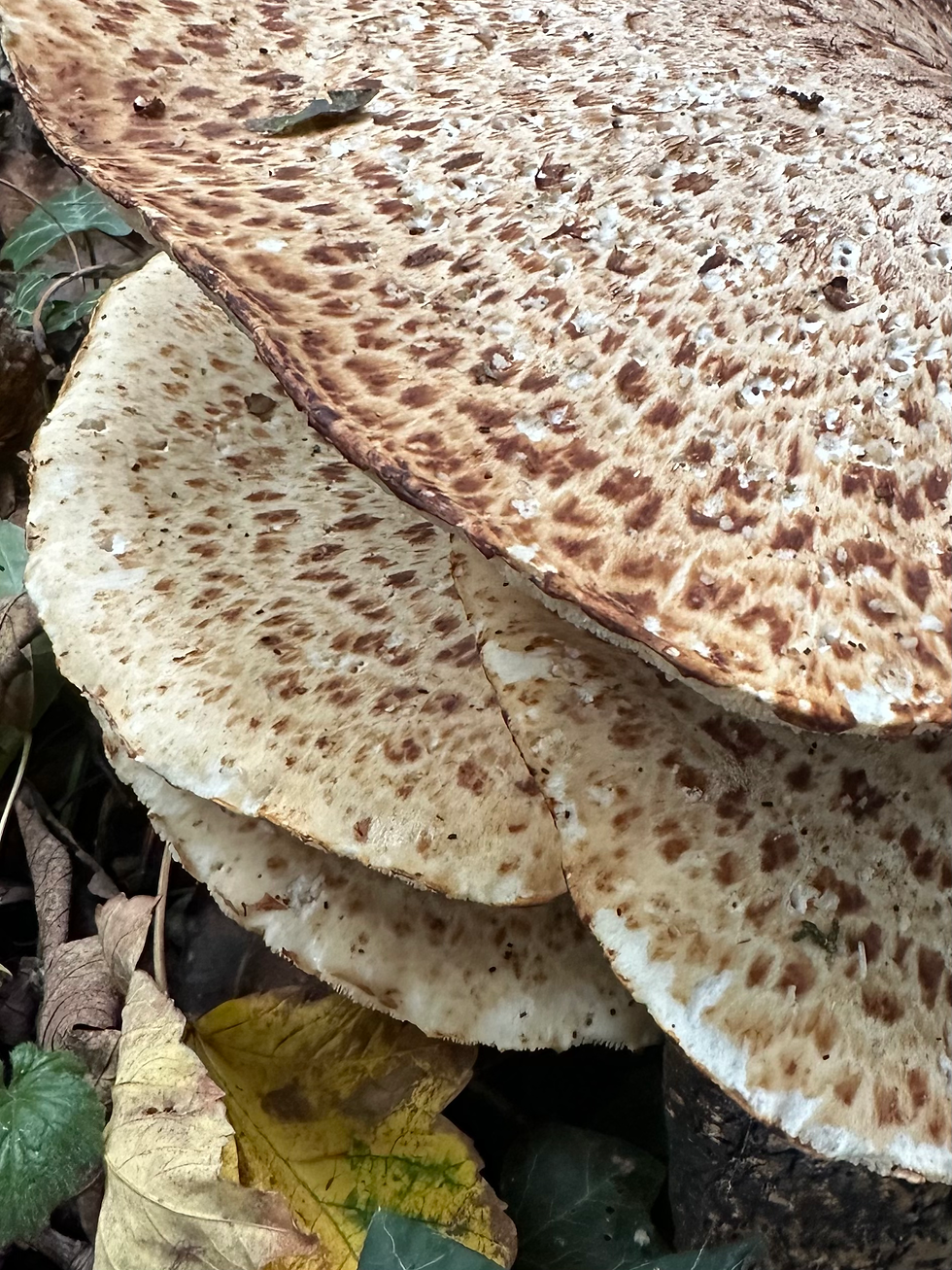
🍄 Habitat: Grows on living or dead broadleaf trees (especially sycamore, elm, beech, and willow). Appears in spring to early summer (though sometimes in autumn too).
🍄 Ecology: A saprobic and weak parasitic fungus – both decays dead wood and weakens living trees.
🍄 Key ID features: Large, saddle-shaped bracket with cream-yellow cap marked in brown scales, white pore surface, cucumber/watermelon smell, and growth on broadleaf wood.

🍄 Note: Edible only when very young and tender (before it gets tough). Always forage with care and certainty.


Comments